Showing posts with label read. Show all posts

24 November 2009

read.

just a little light reading on questions of sex, gender, and culture:


  • on why "chick flicks" are not all that woman-friendly: "7 popular chick flicks that secretly hate women." (be forewarned of some profanity)
  • on the federal court challenge to prop. 8 and the broader related issues: "gay on trial." winning quote: "They [defenders of prop. 8 who oppose gay marriage] also argue that sexual orientation falls on a continuum and that sexuality is 'fluid,' a decidedly nontraditional view that has taken root in college queer-studies departments but not the sort of thing you'd ever hear from Focus on the Family's James Dobson."  i'd just love to see most conservatives who oppose gay marriage swallow that pill.
  • jessawhy's personal articles of faith, a beautiful piece: "my articles of faith."
  • on the romantic paternalism prevalent in the church and the desire to be taken seriously: "romantic paternalism."
  • on the dangers of the twilight saga (and a great example of why we should think just a little more carefully about the entertainment we consume): "ew moon: why twilight continues to hurt america."  winning quotes: "Young girls around the country are debating whether she should choose Edward or Jacob. Which abuse is better? He’s insanely jealous and stalks me or he can barely control his anger and may physically abuse me at any moment?" and " The messages behind Twilight? Be weak, let your man protect you. Be careful, don’t get him angry. If he hurts you, it’s your fault. Abuse is part of life. Accept it. If he really loves you, he’ll try not to hurt you but don’t be surprised if he does. You probably deserve it. You are nobody without your man, so don’t bother trying." is it any wonder that the author of the series is mormon?
  • and, to be balanced, an interesting feminist defense of the twilight saga, which asks some very important questions: "another feminist defense of 'twilight'."
  • and my hero for the week: the ten-year-old boy in arkansas refusing to stand and pledge allegiance because gay marriage is not legal, therefore the nation does not provide "liberty and justice for all." (no reading required, just a fast enough connection to stream video)
go forth, read, and comment.  i'd love to hear what you think.

09 November 2009

library.

tonight i was very disturbed.  you see, i was innocently minding my own business, driving home from a doctor's appointment, when this story came on the radio.  all about a library that GOT RID OF ITS BOOKS.  excuse me!?  how can a library be a library without any books?  it makes no sense!

okay.  granted the library subscribed to a database with millions of digital books.  and it acquired some kindles students can check out.  but i'm very sorry to say digital books and digital book readers do not a library make.

now, don't get me wrong.  i recognize the value of digital resources.  i use them all the time in my own research.  i love searchable text databases.  i love having online access to full text articles.  but i also print up the articles or chapters that i find pertinent to my research.  why? because there's an enormous difference between reading material on a screen and reading it in print format.

it's true that most digital readers allow for annotation in some way or another, but from what i've heard it's cumbersome at best.  i've also been told that accessing footnotes on digital readers is difficult.  both of those tools--annotating a text and accessing that text's notes--are invaluable to academic reading and research.  and then there's the small detail of memory.  i frequently find things in a text because i remember that it was at the top of the left side of a page (or somesuch).  maybe i'm weird, but there's just something more memorable about  a physical text than a nondescript screen of text.

and all of that doesn't even touch the physical beauty of a book and of stacks of books.  there's something magical about a library that cannot be duplicated.  books have lives, beyond the life they contain in their text.  they represent the interests and tastes and loves of the people who owned them, the priorities and emphases of the institutions that acquired them.  when someone dies and leaves behind a library, some part of her continues to live.  when someone gives a book, he also give some little bit of himself.  how could we possibly imagine that a world without books, even one in which all of the same information was immediately searchable and accessible through digital means, would be a world in which we would want to live?

i love digital tools.  i use them all the time.  but i hope i never get to the point that i choose digital texts over my lovely, beautiful, wonderful books.

07 November 2009

books.

i grew up reading.  i remember being six years old and bored, pestering my mother about what i could do.  she took me into the living room, pulled a bobbsey twins novel off the bookshelf, and suggested i read.  so i did.  and i never looked back.


the living room in our house was a treasure trove of books.  novels, poetry, short stories, encyclopedias, dictionaries, art books, books on how things worked, volumes of fiction for children.  you think of a kind of book, and you could probably find it in there.  i thought it was normal to have a full wall of books in a room, to have books in every room of the house.  i didn't realize that some people relegate the few books they have to the closet or only buy books as decorating pieces.  for me, books were a way of living lives i couldn't otherwise access.

and now--now i'm a bit of a book whore, to borrow a phrase from an old professor.  i love just about any kind of book.  fiction, non-fiction, poetry, prose, biographies, essays, history.  i love the feel of a book--the heft of its weight in my hand.  i love the smell of books that you only find in a space filled to the brim with texts.  and i love the look of books on a shelf; there was one particular aisle in the BYU library that i especially loved because most of the spines were red.

but most of all, i love losing myself in a book.  which makes my current task more pleasure than task, since it requires reading and reading and then reading some more (in preparation for my exams).  last week, it was a text about relationships between women, don quixote, and community.  this week, it is the origins of the novel and a novel in verse.  and next week will bring more.  this is a life i could get used to.


{photo by john }

09 May 2009

dilemma.

i just finished reading the omnivore’s dilemma, michael pollan’s “natural history of four meals.”  and i can recommend it wholeheartedly.  it’s a fascinating analysis of the human food chain—of where our food comes from, from its primary source of energy (sun generated calories, plant generated calories) to the methods used to raise and process it.  in his first section, he examines industrial agriculture including both corn monoculture and raising beef (two tightly intertwined operations, thanks to our human intervention with beef cattle’s natural diet [we feed them corn, as if it’s some kind of virtue to be “corn-fed” when in reality eating corn sickens and could kill cattle]).  the extent to which corn dominates industrial agriculture is astounding.  in true pollan fashion, he sets about telling the story of corn not only from the human perspective, but also from the corn’s perspective—as a plant which has successfully enticed humanity into advancing its interests (he makes a similar move in the botany of desire, in which he argues that plants use humans to their evolutionary advantage as much as humans do the same with plants).  


the second section is dedicated to two incarnations of “organic” agriculture, organic in quotes because, having read this section, i realize how tormented that term is.  having toured several organic agriculture operations, including a lettuce farm and a chicken farm, pollan concludes that “organic” agriculture is little different from industrial agriculture in technique, even if it does not rely on chemical in-puts.  his visit to the chicken farm in particular debunks the myths of “supermarket pastoral”—the almost-lyric images and narratives of content chickens and milk cows organic producers use to sell their goods.  who knew that free-range chickens often never step foot out of the hen house, where they live their eight-week lives in the company of thousands like them—just as they do in non-organic industrial chicken enterprises.  while pollan acknowledges the undeniable good of not relying on antibiotics, pesticides, and herbicides, he also reveals the unsustainable nature of “industrial organic” agriculture. 


the other “organic” enterprise he visits is polyface farm, in swoope, Virginia.  “organic” in quotes because the farm is much better described as sustainable, with organic being a by-product of its practices.  maybe even better than “sustainable,” is the word symbiotic.  polyface farm is, in pollan’s description, an intricately choreographed interaction between chickens, cattle, pigs, and—most importantly—grass.  joel salatin, the farm’s proprietor, describes himself as a grass farmer because it is the grass that gives life to all of the animals on his farm.  j(wh) used to tell me about polyface farm and it was interesting.  but there’s no description that can capture the magic of this place without reading about its nature in detail.  i never thought i’d put a farm on my list of must-see destinations, but polyface farm is on that list.  too bad the tours run $1000 (except for a once-a-month free tour, which is what i’ll try to hit sometime when i’m in Virginia).    


the final section of the book is dedicated to food pollan hunts and gathers himself.  his experience learning to hunt and to mushroom is both entertaining and informative.  and the people he encounters as he educates himself are fascinating.  but the magic of this section is in the “perfect meal” he serves at the end, with every dish built around something either he or one of his tutors gathered, hunted, and made. each section ends with pollan’s account of a meal that epitomizes the agriculture he explores—a mcdonald’s meal eaten in a car going sixty miles per hour; an industrial organic meal of chicken and vegetables, including “jet-setting” asparagus from south America (just one example of the hidden costs of “organic” farming); another organic chicken dinner, this time with a chicken and eggs (for a scrumptious-sounding chocolate soufflĂ©) from joel salatin’s polyface farm; and finally the perfect meal of wild pig, wild morels, homemade wine, fresh bread, and cherry galette.  aside from the mcdonald’s meal (which sounded terrible in more ways than one), all the meals sounded delicious.  


the thing that really sucked me into this book is pollan’s ability to reflect on the agricultural realities he discovers in ways that apply to our world at large.  for instance, in a critique of industrial monoculture which relies heavily on chemical inputs, pollan writes: “when we mistake what we can know for all there is to know, a healthy appreciation of one’s ignorance in the face of a mystery like soil fertility gives way to the hubris that we can treat nature as a machine” (148).  this insight, firmly rooted in pollan’s critique of monoculture and fertilizers, resounded with me on many more levels.  so often human beings mistake “what we can know” for “all there is to know” and, in so doing, set themselves up for incredible failures and pain.  pollan taps into the necessity of wonder—wonder at the magic of nature, at the beautifully symbiotic relationships between grass and animals on polyface farm, at the mysterious nature of mushrooms; but also wonder as a necessary ingredient in any human enterprise.  


aside from the magic of polyface farm, i think my favorite section of the book was pollan’s treatment of animal rights, vegetarianism, and carnivorism.  throughout the book, pollan insists on the importance of people understanding where their food comes from.  this theme gets special attention as pollan sets out to hunt his own meat.  in his critique of animal rights philosophers, pollan insists that they transfer human ideas of individualism onto what should rightly be thought of in terms of a community or species.  he points out that, while killing an individual pig might go against that pig’s interests (it does, after all, end the pig’s life), it does not go against the pig’s species’s interests, so long as the killing is done in a sustainable fashion.  in fact, according to pollan, to hunt and gather and consume actually serves the interests of species as they exist in a relationship of “mutualism or symbiosis between species" (320).  


according to pollan, “ancient man regarded animals much more as a modern ecologist would than an animal philosopher—as a species, that is, rather than a collection of individuals.  in the ancient view ‘they were mortal and immortal. . . . an animal’s blood flowed like human blood, but its species was undying and each lion was Lion, each ox was Ox’” (323).  pollan continues to insist that species have as strong interests as individual animals, asking “is the individual animal the proper focus of our moral concern when we are trying to save an endangered species or restore a habitat?” (323).  i would add to pollan’s concern, insisting that we must ask the same question when discussing human interests.  not that an individual human’s rights and interests do not exist and should not be considered; but rather that we must balance individual rights and interests with community rights and interests—something we too often fail to do.  and, similar to ancient man’s view of animals, i think we should see each individual human as Human.  because if we would, we would hesitate to do violence against others.  


all of which going-on is my way of saying ‘read pollan’s book.’  because it’s fascinating and informative.  and because it will make you think. though i should warn you--it may also make you never want to buy eggs from the supermarket again.

27 April 2009

books i'd like to read.

today someone saw the cover of the omnivore's dilemma, and asked me what the dilemma was.  and then he asked me what interest i had in reading about food and farming and etc.  to which i replied that i read all kinds of things.  so here are a few of the things i'd like to read:

the omnivore's dilemma: a natural history of four meals


i don't: a contrarian history of marriage


descartes' bones: a skeletal history of the conflict between faith and reason


traffic: why we drive the way we do


snark: it's mean, it's personal, and it's ruining our conversation


collapse: how societies choose to fail or succeed


the spiral staircase: my climb out of darkness


owls and other fantasies


just to name a few.  and you? what would you like to read?

08 June 2008

booklust.

sometime in november, my brother S called home and reported that he and his colleagues had been taken on a tour of the library of congress. as part of that tour, they had seen various rare books, including a first edition of some blake poetry and books exchanged between whitman and thoreau, among other things. ever since that conversation, i’ve been filled with booklust. there’s something magical about seeing books that old—books that would have been read by an author’s contemporaries; books that show me what the texts i love were like when they were originally published; books with the original supplementary marketing material inside their covers; books with interesting provenances.

when i went to d.c. for a friend’s wedding and S suggested he could set up an appointment at the library of congress for me to see some books, i immediately jumped at the opportunity. so the first day i was there, i made my list—whitman, thoreau, hawthorne, and dickinson from my American interests; eliot, collins, and charlotte bronte from my british interests—and S sent it off in an email asking if it was possible for us to visit the library the following monday. and within half an hour or so we had our answer: monday morning at 11:00 for a visit to the rare books and special collections room and to the manuscripts division.

so that monday morning, S and i made our way from his office through the network of tunnels that runs under capitol hill to the library of congress for our visit. we started in the rare books and special collections room, where we were shown into the rosenwald room to see the books they had pulled for me. the room was beautiful—the furniture, shelves, and dĂ©cor an exact replica of the benefactor’s private library in his home, most of it in art deco style. we sat at a table and the librarian started a grown-up version of show-and-tell:

an original 1830 edition of the book of mormon. i have a replica of this book that my dad gave me, but i’d never stopped and looked at the note from joseph smith to the reader trying to explain the circumstances of the 116 pages lost and the various rumors spreading about him. looking at the original edition made me think about the contemporary readership of that book, which put the note in a context that made me take note. they also presented us with the title page and clerk’s record from an 1829 attempt to copyright the book. apparently there had been intentions to publish it in that year in a slightly larger format, but it never happened.

books exchanged between thoreau and whitman. thoreau paid a visit to whitman in 1856. during that visit, whitman presented thoreau with a copy of leaves of grass and thoreau gave whitman a copy of a week on the concord and merrimack rivers. whitman made a rather extensive note in the front flyleaf of the thoreau recording the visit and the exchange of books. the two books came to the library in two separate gifts and it was only discovered afterwards that they had been exchanged at that 1856 visit. i was a little surprised by the format of leaves of grass. i had been told in a seminar that it was a larger than normal book—something akin to a coffee table book—, but this book was the same size as all the others we saw. maybe my professor was referring to one of the many revised editions whitman published.

dickens’ walking stick with an ivory handle that had a dog’s head carved into it. apparently dickens carried this stick with him regularly. it was very short—probably for someone closer to 5’6 than my own 6’.

the first American edition of wilkie collins’ armadale, which included marketing material inside its front cover. they also had a copy of collins’ play the frozen deep. the cover page attributes it solely to Collins, but has dickens’ name inscribed in pencil below Collins. dickens was heavily involved in editing, writing, and producing the play.

a manuscript copy in kipling’s hand of the first chapter of the jungle book.

lewis carroll’s scrapbook from his college years, in which he collected clippings from newspapers and popular magazines.

a first edition of charlotte bronte’s Shirley. apparently the library doesn’t have much by bronte, which i suppose is not very surprising since she’s british rather than american. the librarian explained that most of the non-american items in rare books and special collections are at the library because they were originally collected and then left to the library by a prominent american.

a first edition of george eliot’s silas marner, which was a lovely example of a Victorian triple-decker.

hawthorne’s house of the seven gables, which i’ll likely be reading in the next few weeks.

poe’s “murder in the rue morgue” in pamphlet form, which left me wondering how most of his stories were originally published.

the first book of dickinson’s poetry published following her death (few of her poems were formally published during her life). i loved flipping through the book to see how mabel loomis todd (dickinson’s brother’s mistress) and thomas wentworth higginson (dickinson’s mentor) edited dickinson’s punctuation, capitalization, and rhyme schemes.

a 19th century American penny press literary newspaper which they just happened to be processing that morning in the rare books room.


after an hour spent perusing rare books, S and i and our host left the Jefferson building for the Madison building, which houses the library’s manuscripts division. we were met by the library’s literary manuscript historian, who took us into the manuscript “ranges” to see what the library had of dickinson, hawthorne, thoreau, and whitman’s manuscripts.

their holdings of dickinson, hawthorne, and thoreau are relatively minor, as most of those author’s original manuscripts are held in ivy league libraries in new england. however, they did have a handful of items for each—some random diplomatic records hawthorne kept while employed by the government; a short essay on education by thoreau, in which he calls for the government to provide universal education; a commonplace notebook in which thoreau recorded passages from books.

my favorite of the small collections was dickinson’s—unsurprising given my fascination with her. they weren’t original manuscripts; they were holograph images of four poems (one with an accompanying transcript) and a letter. but it was wonderful to see her poems in her own hand and to show S how she used dashes rather than standard punctuation and erratic capitalization in her handwritten manuscripts. and the letter had been written significantly earlier than the poems, so we could see the evolution of her handwriting (which is how they’ve dated her poems).

after seeing these small collections, ms. birney took us further into the manuscript ranges to look at the library’s much larger whitman manuscript collection. apparently they have received three or four gifts, leaving them with one of the largest (if not the largest) collections of whitman manuscripts.

she started by showing us manuscripts of several whitman poems, including his most famous poem “o captain! my captain!” which he wrote on the occasion of lincoln’s assassination. it was interesting to see multiple examples of whitman’s poetry, as “o captain! my captain!” differs rather drastically from the poetry he typically wrote in that it uses a fairly standard verse form and rhyme scheme. ms. birney also explained that whitman came to dislike that poem as he was always begged to recite it throughout the remainder of his life whenever he made public appearances.

as she showed us the poetry manuscripts, ms. birney called attention to whitman’s tendency to use any scrap of paper he could. for instance, one poem was originally written on the back of an envelope. she pointed out in one of his commonplace notebooks how he went back to the beginning of the book and wrote information in blank spaces—information dated much later than other information on the same page.

after showing us the samples of poetry and the commonplace notebook, ms. birney told us a tale of bibliographic intrigue. early in the 20th century—something in the twenties or thirties—the library received a gift that included 24 whitman notebooks. and a cardboard butterfly (more on that in a moment). during world war II, the notebooks (and the butterfly) were moved from the main library buildings to a military base for safety purposes. when they were brought back, ten of those 24 notebooks—and the cardboard butterfly—were missing. for more than 50 years those ten missing notebooks and the cardboard butterfly were the American manuscripts directors' mystery. the fbi even had a hand in the investigation.

until one day in the mid-90s when sotheby’s called the ms. birney and explained that they had some whitman notebooks to auction and they had reason to believe they were similar to notebooks once held by the library of congress—were they missing any? to which ms. birney responded: ‘yes, we’re missing ten notebooks and a cardboard butterfly.’ it was the cardboard butterfly that made the sotheby’s representative sure their four notebooks belonged to the library of congress. so ms. birney and the fbi agent made a trip to new york to bring the notebooks—and the butterfly—home.

she showed us one of the notebooks. it used to be called the ‘albot’ notebook, until they realized there was a ‘t’ in front of that. the ‘talbot’ notebook (if you're interested, you can flip through the entire notebook on the LoC webiste). the first few pages had been cut out. the edges of the pages that remained were lined with numbers, so scholars speculate that it had initially been used for bookkeeping. whitman, being a paper conservator (as most people at the time probably were), re-used the book. the early pages were fairly similar to those in the other commonplace notebook. notes jotted quickly. appointments. then he skipped a page or two (remember, he used paper so carefully that he wrote on the backs of envelopes). and after those blank pages came prose writing that was more philosophical and introspective. then two more blank pages. and after that—poetry. lines from ‘song of myself’ immediately recognizable to anyone who’s every spent much time with that poem. seeing those lines of poetry and recognizing them was a magical moment--understanding that this notebook contained the evolution of a brilliant man’s thought and style.

and then there was the cardboard butterfly. it was brilliantly colored on one side. and on the reverse there was an easter poem (not whitman’s). if you look closely at the butterfly, you’ll find a thin wire that runs through its body. that’s because whitman, being the rather eccentric man he was and being a bit obsessed with self-portraits, used the wire to attach the butterfly to his finger and pose for a picture.

my day in the library was wonderful. i couldn’t have asked for a better excursion. even if you can’t make private appointments to meet with librarians, take the time to go there next time you’re in d.c. the building and the public exhibits are well worth the visit.

04 March 2008

titled.

sometimes i read in barnes & noble. if luck is with me, i find a big cushy armchair and settle in for a few hours of reading. my view from those chairs looks like this:i like looking up and perusing book titles on occasion. it's interesting to see what people write about. how they represent that work to readers. how the title and the cover art work together.

lately i seem to find my cushy chairs in the current affairs section. and i've been struck by some of the titles. a few examples:
  • by ann coulter how to talk to a liberal (if you must): the world according to ann coulter and if democrats had any brains, they'd be republicans. on the covers of which coulter does her best to look sexy.
  • another conservative commentary: conservative comebacks to liberal lies. touted as a 'national best seller.'
  • a liberal approach of the same stripe: the GOP-hater's handbook: 378 reasons never to vote for the party of reagan, nixon & bush again. with a picture of an elephant's backside with a target on it.
these are all relatively amusing when seen for what they are--trash. they're less amusing when you realize that people might actually believe what's written in them.

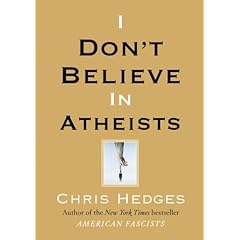
the one that caught my eye the most--and the reason i'm writing this--is i don't believe in atheists, by chris hedges. take a look at the cover:

this book, like the others, aims to shut down conversation rather than open up opportunities to learn and understand. the title reminds me of a scene in kushner's angels in america. harper--the agoraphobic, valium-popping wife of kushner's gay mormon--encounters prior--the AIDS patient who sees visions of angels--in a hallucination or a dream or some alternate reality. she tells him that in her church, they don't believe in homosexuals. now, i've been raised mormon and i don't think i'd ever come up with that statement on my own--mormons don't believe in homosexuals. but i understand how someone could make that statement. and it bothers me. because to dismiss someone else by saying you don't believe in one of the groups they belong to--you don't believe in their professed identity (whether sexual or spiritual or whatever version of identity)--well, it's a neat way to avoid any real engagement. and it's an assertion that you understand the other person's reality and experience better than they do.

i was also struck by hedges' title because of its graphic design. the white words 'i' and 'in' easily disappear against the gold background, especially when the book sits on a shelf under bright lights. and when they disappear, an imperative remains: 'don't believe atheists.' with the picture of god's enormous hand pressing down against puny man. opinion becomes dictate--and one with divine sanction.

the imperative and the image made me think of how easily religious believers attempt to dismiss atheists as immoral, anchorless, lost human beings who may deserve our pity, but who certainly don't deserve our respect. of course, this response isn't reserved for atheists. i know believers who respond similarly to those of other faith traditions--especially traditions that do not resemble their own. i've also encountered a few atheists who react this way towards believers.

i don't like the reaction no matter where i encounter it. it's too self-assured. too convinced that i am right and they are wrong, end of story. i don't like it because when argumentative amelia emerges, she's willful and adamant and articulate and passionate but she's usually not listening. i don't like that when i'm convinced i'm right and 'they' (whoever they are) are wrong, i stop making the effort to understand. to think in new ways. to recognize the realities of someone else's life.

i'm not always good at keeping argumentative amelia on a leash. but i've been trying. if she's reared her ugly head in your direction, do accept my apologies. and know that i'm more interested in understanding than in being right. so give me another chance. because i don't want people to walk away from me feeling like the title across my forehead reads 'i don't believe in X' or 'don't believe x.'

29 February 2008

read.

just because book memes are fun (look for another one in a day or two). and because i don't really feel like grading at the moment.


to join in the fun, copy the list and then:

Bold the ones you’ve read,

italicize the ones you want to read,
cross out the ones you won’t touch with a 10 foot pole,
put a cross (+) in front of the ones on your book shelf,
and asterisk (*) the ones you’ve never heard of.

1. The Da Vinci Code (Dan Brown)
2. +Pride and Prejudice (Jane Austen)
3. +To Kill A Mockingbird (Harper Lee)
4. Gone With The Wind(Margaret Mitchell)
5. The Lord of the Rings: Return of the King (J.R.R. Tolkien)
6. The Lord of the Rings: Fellowship of the Ring (J.R.R. Tolkien)
7. The Lord of the Rings: Two Towers (J.R.R. Tolkien)
8. +Anne of Green Gables (L.M. Montgomery)
9. *Outlander (Diana Gabaldon)
10. *A Fine Balance (Rohinton Mistry)
11. +Harry Potter and the Goblet of Fire (J.K. Rowling)
12. Angels and Demons (Dan Brown)
13. +Harry Potter and the Order of the Phoenix (J.K. Rowling)
14. A Prayer for Owen Meany (John Irving)
15. Memoirs of a Geisha (Arthur Golden)
16. +Harry Potter and the Sorcerer's Stone (J.K. Rowling)
17. *Fall on Your Knees (Ann-Marie MacDonald)
18. The Stand (Stephen King)
19. +Harry Potter and the Prisoner of Azkaban (J.K. Rowling)
20. +Jane Eyre (Charlotte Bronte)
21. The Hobbit (J.R.R. Tolkien)
22. +The Catcher in the Rye (J.D. Salinger)
23. +Little Women (Louisa May Alcott)
24. +The Lovely Bones (Alice Sebold)
25. +Life of Pi (Yann Martel)
26. The Hitchhiker's Guide to the Galaxy (Douglas Adams)
27. +Wuthering Heights (Emily Bronte)
28. The Lion, The Witch and the Wardrobe (C. S. Lewis)
29. +East of Eden (John Steinbeck)
30. Tuesdays with Morrie (Mitch Albom)
31. Dune (Frank Herbert)
32. The Notebook (Nicholas Sparks)
33. +Atlas Shrugged (Ayn Rand)
34. +1984 (George Orwell)
35. *The Mists of Avalon (Marion Zimmer Bradley)
36. *The Pillars of the Earth (Ken Follett)
37. The Power of One (Bryce Courtenay)
38. *I Know This Much is True (Wally Lamb)
39. The Red Tent (Anita Diamant)
40. *The Alchemist (Paulo Coelho)
41. *The Clan of the Cave Bear (Jean M. Auel)
42. +The Kite Runner (Khaled Hosseini)
43. Confessions of a Shopaholic (Sophie Kinsella)
44. The Five People You Meet In Heaven (Mitch Albom)
45. +Bible
46. +Anna Karenina (Leo Tolstoy)
47. The Count of Monte Cristo (Alexandre Dumas)
48. Angela's Ashes (Frank McCourt)
49. +The Grapes of Wrath (John Steinbeck)
50. She's Come Undone (Wally Lamb)
51. +The Poisonwood Bible (Barbara Kingsolver)
52. +A Tale of Two Cities (Charles Dickens)
53. +Ender's Game(Orson Scott Card)
54. +Great Expectations (Charles Dickens)
55. +The Great Gatsby (Scott Fitzgerald)
56. *The Stone Angel (Margaret Laurence)
57. +Harry Potter and the Chamber of Secrets (J.K. Rowling)
58. The Thorn Birds (Colleen McCullough)
59. +The Handmaid's Tale (Margaret Atwood)
60. The Time Traveller's Wife (Audrew Niffenegger)
61. +Crime and Punishment (Fyodor Dostoyevsky)
62. +The Fountainhead (Ayn Rand)
63. War and Peace (Tolsoy) {i read half of it, anyway; and that's got to count for something with a 1500 page book.}
64. Interview With The Vampire (Anne Rice)
65. *Fifth Business (Robertson Davies)
66. +One Hundred Years Of Solitude (Gabriel Garcia Marquez)
67. The Sisterhood of the Travelling Pants (Ann Brashares)
68. +Catch-22 (Joseph Heller)
69. Les Miserables (Victor Hugo)
70. +The Little Prince (Antoine de Saint-Exupery)
71. +Bridget Jones' Diary (Helen Fielding)
72. +Love in the Time of Cholera (Gabriel Garcia Marquez)
73. Shogun (James Clavell)
74. The English Patient (Michael Ondaatje)
75. The Secret Garden (Frances Hodgson Burnett)
76. *The Summer Tree (Guy Gavriel Kay)
77. +A Tree Grows in Brooklyn (Betty Smith)
78. The World According To Garp (John Irving)
79. *The Diviners (Margaret Laurence)
80. Charlotte's Web (E.B. White)
81. *Not Wanted On The Voyage (Timothy Findley)
82. Of Mice And Men (John Steinbeck)
83. +Rebecca (Daphne DuMaurier)
84. Wizard's First Rule (Terry Goodkind)
85. +Emma (Jane Austen)
86. +Watership Down (Richard Adams)
87. +Brave New World (Aldous Huxley)
88. *The Stone Diaries (Carol Shields)
89. *Blindness (Jose Saramago)
90. *Kane and Abel (Jeffrey Archer)
91. *In the Skin of a Lion (Michael Ondaatje)
92. Lord of the Flies (William Golding)
93. The Good Earth (Pearl S. Buck)
94. +The Secret Life of Bees (Sue Monk Kidd)
95. The Bourne Identity (Robert Ludlum)
96. The Outsiders (S.E. Hinton)
97. White Oleander (Janet Fitch)
98. A Woman of Substance (Barbara Taylor Bradford)
99. The Celestine Prophecy (James Redfield)
100. +Ulysses (James Joyce)


14 February 2008

six.

and seven. because for valentine's day, you get two kooser treasures.


Screech Owl

All night each reedy whinny
from a bird no bigger than a heart
flies out of a tall black pine
and, in a breath, is taken away
by the stars. Yet, with small hope
from the center of darkness
it calls out again and again.


This Paper Boat

Carefully placed upon the future,
it tips from the breeze and skims away,
frail thing of words, this valentine,
so far to sail. And if you find it
caught in the reeds, its message blurred,
the thought that you are holding it
a moment is enough for me.


i love these two. because i've spent so much of my life hoping for love. and no matter how much that hope seemed to simply disappear in darkness, i never lost it. and because loving feels like sending something fragile out into the world, knowing it could so easily be tattered and torn. but also knowing that if it's received, it's enough. even if it's no longer what you thought it should be when you sent it out. it's more beautiful when i let it be without trying to fit it to 'shoulds' and 'oughts.'

13 February 2008

five.

The Bluet

Of all the flowers, the bluet has
the sweetest name, two syllables
that form on the lips, then fall
with a tiny, raindrop splash
into a suddenly bluer morning.

I offer you mornings like that,
fragrant with tiny blue blossoms--
each with four petals, each with a star
at its heart. I would give you whole fields
of wild perfume if only

you could be mine, if you were not--
like the foolish bluet (also called
Innocence)--always holding your face
to the fickle, careless, fly-by kiss
of the Clouded Sulphur Butterfly.


what a dilemma--the whimsy of a butterfly or the lure of fragrant flowers. i admit--i could be distracted momentarily by the butterfly. but mornings full of scents i love bring peace. i think i'd choose the bluet morning...

12 February 2008

four.

In the Alley

In the alley behind the florist's shop,
a huge white garbage truck was parked and idling.
In a cloud of exhaust, two men in coveralls
and stocking caps, their noses dripping,
were picking through the florist's dumpster
and each had selected a fistful of roses.

As I walked past, they gave me a furtive,
conspiratorial nod, perhaps sensing
that I, too (though in my business suit and tie)
am a devotee of garbage--an aficianado
of the wilted, the shopworn, and the free--
and that I had for days been searching
beneath the heaps of worn-out, faded words
to find this brief bouquet for you.


i wish i could make such beautiful bouqets out of words.

11 February 2008

three.

In a Light Late-Winter Wind

In a light late-winter wind
the oak trees are scattering valentines
over the snow--dark red
like the deep-running, veinous blood
of the married, returning
again and again to the steady heart.

This leaf is yours, friend,
picked from the heart-shaped hoofprint
of a deer. She stood here
under the apple tree during the night,
kicking up sweetness, her great eyes
watching the sleeping house.


i love watching leaves fall--drifting aimlessly towards the ground and then, sometimes, catching an updraft and dancing back toward their homes before succumbing to gravity again. and i love that kooser has turned them into little tokens of love.

10 February 2008

two.

another treasure from ted kooser's book of valentine poems:


Chocolate Checkers

In a tiny green park, chopped out
of a corner of Commerce, I saw
two men in rags with their backpacks
lying beside them. Red nose to red nose
and old boots toe to toe, they were
playing a game of chocolate checkers,
using candy for pieces, and eating
the pieces they'd won from each other
and laughing like crazy.
It was Commerce
who'd given this park to the city,
and Commerce looked on--the bank
and the telephone company
standing behind mirrored windows,
disapproving--not of chocolate checkers,
per se, but of that kind of people,
laughing and playing with candy
on an imported Italian marble table
with neatly set black-and-white tiles.

09 February 2008

poem.

a couple years ago, my friend pam told me about then poet laureate ted kooser's valentine poems. a simple poem written and mailed each year for valentine's day. i helped her find a handful of his poems online and was struck by their earthy simplicity. so when i saw a collection of his poems titled simply valentines during one of my many visits to a bookstore, i picked it up. i immediately fell in love with the first poem. today i bought myself the book, after having picked it up longingly at least half a dozen times. here's the first poem:


Pocket Poem

If this comes creased and creased again and soiled
as if I'd opened it a thousand times
to see if what I'd written here was right,
it's all because I looked too long for you
to put it in your pocket. Midnight says
the little gifts of loneliness come wrapped
by nervous fingers. What I wanted this
to say was that I want to be so close
that when you find it, it is warm from me.


i loved it so much that i wanted to share.

16 September 2007

finished.
i finished the third book in the saga of bella and edward this morning. which is probably a good thing, since reading them made me adopt a somewhat vampirish existence. i ate brunch on thursday at 10:30 and a snack about 2:30. but then i started reading before eating dinner and i just read and read and stayed up all night (til 6:30 friday morning) to finish new moon. and of course after my four or so hours of sleep friday morning (wearing an eye mask to keep out the light--first time and it worked great), i had to start the third one. i didn't eat again until a snack around 4:00 and dinner around 6:30 on friday. and after my eight hour trip to l.a. (to see pink martini in concert, which was fabulous), i stayed up til 3:30 reading more. apparently i was obsessed enough with edward to adopt his sleepless, foodless lifestyle...

they're not great literature. but they were great reads. if you want a little vampire romance (and even if you're not sold on the whole vampire thing), they're definitely fun. a more extensive review to come (when it's not 12:45 a.m. after two nights of little sleep).

14 September 2007

bitten.
i'm in love with edward cullen. yesterday, before my five hours of poetry, i picked up stephanie meyer's twilight and read the first chapter. i liked it. but i had to read poetry. today, after working all morning and then an afternoon appointment, i decided to go back to barnes & noble to read more poetry. but first i thought i'd read one more chapter in twilight. five hours later, i finished the book head-over-heels in love with its undead hero. and now it's 11:41 p.m. and i have a drive to and from l.a. to make tomorrow and work to do in the morning. and i really shouldn't start new moon. but edward's kiss beckons...

13 September 2007

denial.
this afternoon i read poetry. all afternoon. working on the syllabus for a class i've never taught before. shakespeare. donne. marvel. finch. keats. bradstreet. wordsworth. shelley. coleridge. wheatley. emerson. behn. among others. (tomorrow i get to do the 19th and 20th centuries--yay!) i love it. and it intimidates the hell out of me. i fluctuate between excitement and feeling terrified. but mostly i'm excited.

i made a point of reading poems by george herbert today. i've always loved herbert, but before today it was an academic kind of love. it was the way he made the shape of his poems and their meanings coincide. i've long been fascinated by texts which use their physicality to create layers of meaning, so discovering herbert was one of the highlights of the rather boring early british lit survey course i took as an undergrad (the other highlight was my professor, who regularly wore suspenders with pigs on them and who did a spot-on thomas s. monson impression).

today i loved herbert for much more than his form. "prayer (I)," in which he describes prayer as "the soul in paraphrase," "Christ-side-piercing spear," "Heaven in ordinary," and "something understood." the image of man as "brittle crazy glass" given, through the grace of god, the "glorious and transcendent place, / To be a window" in god's temple. herbert's poetry is achingly beautiful--full of a spiritual insight so pointed it pierces through layers of obscuring fear and self-delusion.

i particularly loved "denial." i'll type it here, but you should follow the link to see it's format (if only i could figure out how to format things better through blogger).

Denial

When my devotions could not pierce
Thy silent ears,
Then was my heart broken, as was my verse;
My breast was full of fears
And disorder.

My bent thoughts, like a brittle bow,
Did fly asunder:
Each took his way; some would to pleasures go,
Some to the wars and thunder
Of alarms.

'As good go anywhere,' they say,
'As to benumb
Both knees and heart, in crying night and day,
Come, come, my God, O come!
But no hearing.'

O that thou shouldst give dust a tongue
To cry to thee,
And then not hear it crying! All day long
My heart was in my knee,
But no hearing.

Therefore my soul lay out of sight,
Untuned, unstrung:
My feeble spirit, unable to look right,
Like a nipped blossom, hung
Discontented.

O cheer and tune my heartless breast,
Defer no time;
That so thy favors granting my request,
They and my mind may chime,
And mend my rhyme.

so many times i've felt this. the frustration. the anger. the sorrow. of asking and seeking and begging. 'but no hearing.' but i always come back. because when i am 'unable to look right,' i know the only answer is to go to god and ask him to mend me. to 'cheer and tune my heartless breast' so that in granting that favor--the favor of re-tuning my spirit--i can align my will with his, rather than continuing to let my imperfect vision control what i seek.

herbert captures this perfectly. the anger that masks the anguish. and, when neither the anger nor the anguish gets me anywhere, the quiet turning back to god. and, god willing, for a time it's peace not denial that colors my relationship with him.

30 April 2007

five.
questions from caroline, who in turn got her questions from jana.

1. who are your two favorite authors--one prose, one poetry, and why?
ah. the favorite author question which always stymies me. i can't definitively name favorites, but i'll give you two from my larger group of favorites. poetry: emily dickinson. she's always up there. because she packs a lot into a small package. because she's irreverently spiritual. because she has a slant approach to truth. prose: i really truly do not know. so i'll just say arundhati roy cause i'm looking forward to reading the god of small things again. it's a gorgeous, disturbing novel that completely entranced me on my first reading and about which i have written twice and about which i will undoubtedly write again. a fascinating examination of boundaries and identity in relationship to love.

2. what were the saddest and happiest moments of your day (friday, when caroline sent these)?
saddest: that's tough cause friday was all in all a very good day. maybe getting home from the arcade fire concert at 1 in the morning and realizing that i couldn't hear them live again. i quickly decided i should go to their show in l.a. next month. that's a pretty rare day for me; i usually have much sadder moments brought on by my own ineptitude or by the news. happiest: well, there was the post-concert euphoria that stayed with me all day. but a single moment? probably while i was looking at matisse's 'the black shawl (lorette vii)' because i had one of those moments when image and reality came together in a provocative way.

3. what is your favorite thing to do on a saturday?
getting out in the world to discover something new, whether it's a museum or other cultural event or a restaurant or a mountain trail. and preferably done in company with good friends.

4. if you were a congresswoman, what is the first thing you would try to accomplish?
well, there are a million things i'd like to see change. but highest priority in my mind is addressing international crises--first and foremost the situation in darfur. i don't know exactly what steps i'd take, but there are a few. divestment of any and all government funds invested in corporations that do business with the sudanese government. imposition of sanctions against the sudanese government. a more powerful mandate for the african union and greater u.n. involvement. there's a start.

5. what's your favorite flower?
another impossible question. there are just way too many. but i'm going with the predictable: roses. but not for the predictable reasons. i like hot house roses, but i prefer the more chaotic beauty of roses on bushes. there's just something so profligate in their beauty. that said, i have yet to meet a flower i didn't love.

{if you want five questions of your own, leave me a comment telling me so. you should include either an email address so i can send you questions. or you can leave a link to your blog and i'll post questions in a comment.}

29 April 2007

explore.
i had a perfectly lovely weekend. i listened to great music. i ate good food. i explored a little more of my world. and i got my first sunburn of the season. here's a brief rundown:

art. i spent friday afternoon (after an hour and a half in traffic) wandering the norton simon. it's a beautiful little museum in pasadena with an impressive collection. i started with the 20th century and worked my way back in time and ended up in the scuplture garden, where the water lilies are promising to burst into bloom anytime. i didn't take the time to go downstairs to the asian collection, prefering to spend my time contemplating the works i loved rather than cramming it all in. i'll go back, i'm sure. my favorites:
  • picasso's 'woman with a book.' a brilliantly colored portrait that i'd never seen before. i love its combination of dramatic lines and air of contemplation.
  • matisse's 'the black shawl (lorette vii).' i love the way that black shawl is simultaneously insubstantially transparent and inescabably heavy--almost confining. it seems a fitting representation of beauty and sexuality.
  • adam and eve. luminous. and such a fascinating mix of innocence and sensuality.
  • the humanity of joseph holding the infant christ; personality captured in portraits; and the dutch tendency to include insects in still lifes of cut flowers (as i looked at a couple, it struck me as a humorous trend).
  • as much as the dutch cut flowers amused me, it was cezanne's tulips that i loved.
  • and rodin's burghers of calais always absorbs me, especially the figure of pierre de wissant. the norton simon has the full size nude and clothed studies of de wissant as well as the ensemble. rodin's ability to capture intense emotion through hand and foot gestures and with exaggeration amazes me.
books. on saturday, i spent my afternoon at the l.a. times book festival. it takes place every spring on ucla's campus. with 300 exhibitors and hundreds of authors in attendance, it's a book lover's kind of event. i found a few treasures to be given as gifts. and a book or two for myself. the highlights include:
  • meeting bill peet's son. as a child, i knew exactly where bill peet's books were in the children's room at our local library. his stories of creatures in crisis and fantastic beasts fascinated me. there's something almost magical about forging a real life connection (no matter how brief or secondary) with the source of one of my childhood dream worlds. if you don't know bill peet's books, you should.
  • walking ucla's campus. i'd never been there before. it's a gorgeous campus.
  • taking a break for a diddy riese ice cream sandwich and an hour spent reading aeschylus.
  • don cheadle and john prendergast's presentation based on their new book, not on our watch, about the crisis in the darfur region of sudan. their passion about the issue was inspiring. and their suggestions for actions practical, with potential to effect real change. i was frustrated that the corporate sponsor cut short their presentation in order to have them sign books. they had been scheduled to speak until about 4:45 and then spend an hour signing, but for some reason they couldn't stay as long as previously planned. so barnes & noble's shill tried to end the presentation and Q&A at 4:30. the crowd (with my vociferous contribution) called for more Q&A, rather than the signing, but needless to say a corporate sponsor couldn't give up the opportunity for a marketing event in favor of disseminating actual information. i'll be writing more about this book (which i bought and started reading last night) and this cause.
food. i stayed with RAF and JP overnight. which of course meant i could count on not only great company, but also wonderful food.
  • mexican at la cabinita in montrose. not the best mexican RAF and JP have introduced me to in the last couple of months (that distinction is reserved for another restaurant which shall remain nameless for all but the lucky few), but incredibly good. some yummy cheesy, creamy spread with fresh corn tortillas for an appetizer. followed up with some very good carnitas. and topped off with a positively delicious guava and cream cheese empanada.
  • RAF's homemade chocolat chaud. which is positively, absolutely delicious. so completely decadent. a lovely way to start a day. followed up by his homemade pancakes. which were wonderful. and i'm a little demanding in my expectations of pancakes. i eat them with nothing but butter, so there's no syrup or sugar or fruit to mask their quality. these passed with flying colors.
and between my excursions, i had a few hours spent in the company of RAF and JP, complete with great conversation, my first ever northern exposure episode, and photos of paris and london.

as you can see, it was a fabulous weekend. and to top it all off, i got to raise temperatures a notch or two today for the, ahem, rather conservative member of my sunday school class by suggesting that the society in which christ lived was sexist (shocking of me, i know).

25 April 2007

satisfied.
a few discoveries and experiences that have left me feeling happy.

decadent.
  • delicious. it's official: thai nakorn is back. and it's as wonderful as ever. after not having had the absolute perfection of beef panang curry and barbequed catfish, among many other delicious options, for nearly five months, it was heaven to partake again. if you like thai (and you should; if you don't there's something wrong with you), you need to get yourself to the new location. 11951 beach boulevard in stanton (at the intersection of chapman and beach). go. indulge. and give your support to this fantastic restaurant run by some of the nicest people i've met. you won't regret it.
  • christian constant. RAF just returned from a whirlwind trip to paris and london. and wonderfully thoughtful man that he is, he returned with a stash of christian constant chocolate for me. four perfect bars of dark chocolate, each with its own distinct flavor based on where the cacao beans were grown. and this time a box of truffles with fillings infused with flowers including tuberoses, frangipani flowers, tahitian vanilla flowers, and more. i'm salivating thinking about them but i need the thai-fullness to wear off.
  • macarons. as if the christian constant weren't enough, RAF also brought a selection of macarons from laduree, the home of the 'new' macaron which sandwiches flavored garnishes between two traditional macarons. i can't wait to sample these beautiful little pastries.
stories.
  • vampires and demons. i've been re-reading dracula this week, as i'm teaching it in my lit class this quarter. and i'm remembering just how fun this book is. it's totally unpredictable in spite of the cultural capital it carries in our society. even having read it before, i'm still surprised by its twists and turns. it will keep you turning pages. it's a fascinating glimpse into the world of the victorian fin-de-siecle--a world of high speed transportation, fabulous new inventions, and crumbling social mores. and it's a compelling examination of the way humans define themselves by establishing, and attempting to police, nebulous borders which are always subject to violation.
  • jekyll & hyde. another literary classic that's become such a commonplace in our cultural language that many never bother to check out the original. a quick and entertaining read, the strange case of dr. jekyll & mr. hyde remains startlingly current in spite of its rather far-fetched science. in the fraught cultural atmosphere resulting from last week's tragedy at virginia tech, jekyll & hyde gave my students and me an opportunity to examine the ways we demonize those who commit atrocities in an effort to understand the inexplicable and to reassure ourselves that we could never commit such acts ourselves.