"i beg you . . . to have patience with everything unresolved in your heart and to try to love the questions themselves as if they were locked rooms or books written in a very foreign language. don't search for the answers, which could not be given to you now, because you would not be able to live them. and the point is, to live everything. live the questions now. perhaps then, someday far in the future, you will gradually, without even noticing it, live your way into the answer." --rainer maria rilke, letters to a young poet
i encountered this passage from rilke again yesterday, this time on a quotable magnet in barnes & noble. and there, in the middle of busy, superficial fashion island, it spoke to me again.
i want to live this way, loving the unresolved questions of life, embracing them as bearers of knowledge and wisdom that living will bring. there is so very much that is uncertain in this world. far more than there is that is known and understood. i want to coexist with the questions, rather than beat them out of existence with pompous certainty. i want to wrestle with them, as jacob wrestles the angel--struggling all through the night and, even in the face of injury, demanding a blessing. and the blessing? a new name: israel, or 'one who has prevailed with god.' i believe god lies not in the answers, but in the questions. in living them fully and struggling with them honestly, rather than giving pat answers which gloss over the messiness of life and truth and god. and i believe if we live honestly these questions, this messiness, we will live our way into answers, prevailing even with god.
10 October 2009

07 October 2009
failure.
ever tried. ever failed. no matter. try again. fail again. fail better. --samuel beckett
i've been thinking about failure lately. it's an interesting thing, failure, because its definition is slippery. what does it mean to fail? does it mean not to accomplish what you set out to accomplish? does it mean to disappoint others by not accomplishing what they expected you to accomplish? does it mean not hitting certain benchmarks of success on a prescribed timeline?
at different moments in my life, failure has meant each of those things. i've nearly dropped out of grad school more times than i can count. each time i felt disappointment in my own failure to achieve what i had planned to achieve. but each time i also felt a wonderful sense of release and opportunity for a fresh start. and i have been accutely aware of the ways in which i have failed to conform to the expectations of others, both in my family and in my church community. but these failures don't feel like personal failures; they feel like explorations and discoveries, my true self emerging from beneath layers of prescription.
the most difficult version of failure i've had to deal with is the failure to achieve life goals on the timeline i've always been taught to accept. i'm 34 and unmarried. i have no children. purchasing a house seems like a distant fantasy. i'm still a student after 14 years of school, and will be for another three. finding a job in my field seems an even more distant fantasy than owning a house. and then there's the complication of being unsure i even want to accomplish those goals. it's a constant struggle to remind myself that it's okay not to have achieved these benchmarks by age XX, that it's okay to be different from the prescribed norm i grew up with. when i fail to remind myself of that, i begin to fail in other ways, too. because dwelling on the fact that where i am in life constitutes failure according to some grand schema developed by someone else interferes with my ability to succeed in my pursuits, making failure all the more likely. it's a self-fulfilling prophecy. not only do i end up a failure according to the prescribed metanarrative, but also according to my own ideas of what it means to be happy and successful.
so i try. i try to remember that i don't want to be married; rather i want to be married to the right person with whom i can have the kind of relationship i want. i try to remember that there is still time to accomplish my goals and many avenues to them, not just one. i try to remember that owning a home is not, in and of itself, a good thing; that sometimes there are alternative and more sustainable ways of living. and mostly i try to remember that the only measuring stick that matters is my own conscience, not others' prescriptions.
02 October 2009
afternoon.
it's friday afternoon. i've had a delicious mid-afternoon nap. and now i've steeped myself a pot of my favorite rubyfruit tea. my new apartment is clean and already feels like my home. there's a picasso on one wall, a matisse on another, and a hopper on a third. and now i'll settle down with my tea and my book and make progress on my work. and life--life is very good.
and you? how have you spent your friday afternoon?
and you? how have you spent your friday afternoon?
17 September 2009
capable.
so this year, i'm on my own. where school is concerned, that is. i'm out of funding until i pass my exams (which i should have passed ages ago). so i'm paying my own way this year. which means i'm dependent on financial aid. can't pay tuition without a loan. and yesterday--yesterday i got this horrible message form the financial aid office telling me i wasn't eligible for financial aid due to insufficient academic progress. mind you, this is one day after i put nearly $4,000 in tuition on my credit card, depending on my loan to come through to pay it off.
so i panicked. for about 45 minutes. just sat on my bed with thoughts of failure and not being able to finish my program whirling through my head. it was miserable.
and then i snapped myself out of it and got to work. prepped a brief lesson for my classes. got to school to teach. let my students out a bit early each hour so i could make phone calls while campus offices were open. i made an appointment with the ombudsman to begin the appeals process. i emailed a faculty mentor to get her advice. i emailed the chair of graduate studies to alert him to the situation and ask if we could meet to discuss it. i called the office that helped me procure a leave of absence last year to see if they could help advocate for me. i did everything i could think of to set an appeal in motion and get my ducks in a row.
everything except talk to the financial aid office, that is. because they never answered their phone, there was no voicemail option (even though their phone said there was) and no email option (even though their website said there was). it was very frustrating.
so first thing this morning i went to campus to visit the financial aid office. where i discovered there had been a clerical error. their computer had not registered that i was on academic leave last year and so had disqualified me. three minutes and it was fixed. i should get my financial aid award tomorrow.
and i am proud of myself. a year ago i would have had a massive panic attack had this happened. and then just given up. six months ago, i would have melted into a puddle of tears. but yesterday i did what needed to be done. calmly and rationally assessing the situation and finding alternatives. it felt lovely. it's so good, after years of depression, to feel like myself. to be capable and productive.
so here i go. back into the breach, prepping for exams which i will take in may or june. and next year i will write two chapters of my dissertation, with a third during the summer, so that fall of 2011 i can go on the job market. and june of 2012 will see me robed to receive my third degree. just watch and see.
05 September 2009
happiness.
so yesterday was my birthday. and i cannot say how glad i am to put a close to the last year--to heartbreak and major depression and everything that comes with it. i've been thinking back over the year and have to admit that i don't have many more answers now to the questions i was asking then, but i am much happier. and it is good to be happy. so here are a few things that make me happy:
- thai nakorn. i just can't get enough. and, happily, they have reopened their original location.
- a day at disneyland with a friend. for free!
- a birthday shopping spree at anthropologie. that store is pure evil...
- a beautiful new niece who i can't wait to meet at christmastime.
- four rambunctious, mischievous nephews and an evening at chuck e. cheese's.
- making progress on my school work.
- seeing a copy of homer's iliad in the front seat of a slightly beat up full size pick-up.
- wonderful food and conversation with friends--not only at our birthday dinner, but often.
- a beautiful, cozy new scarf to take with me on my winter trip to new york.
- my good friend george's happiness in her new relationship.
- spending time with my beautiful little nieces, my little sister, and her wonderful husband.
- evenings out with my siblings and their spouses and our parents.
in short, life has made me happy. and that in spite of the fact that not everything is peachy keen. and i like being happy.
19 July 2009
perfection.
here's a recipe for a perfectly lovely summer evening:
- picnicking in the lovely palm garden of the huntington library and gardens
- antipasto followed by stuffed grape leaves
- an amazing salad of arugula, delicious heirloom tomatoes, full cream mozzarella cheese all drizzled with olive oil and sprinkled with salt and pepper
- munching on brownie, tart tatin, and fruit tart
- music filtering through the trees
- children dancing to the music
- sampling original recipe, made-with-cane-sugar dr. pepper---slightly fruitier and less carbonated than the typical stuff
- wonderful conversation with doctor dean and doctor doctor
- visiting the american art collection to see paintings by my favorite portraitist
that, my friends, is just about the most perfect evening possible.
11 July 2009
comfort.
tonight i needed comfort food. it's been a busy week dogsitting. then last night there was some unpleasantness, which i helped cause but which i did not seek. and that unpleasantness disrupted my sleep, so i'm operating on three hours or so. and my life is a bit of a mess. and i don't know what i want to be when i grow up but i'm already grown up, so that's a bit of a problem. and i have a massive headache that won't go away.
so i needed comfort food. which is why i ended up at thai nakorn. because thai nakorn is like a second home, where everyone says hello and i'm greeted with a hug and the air is full of rich delicious aromas and the food is always divine. and it's the site of many wonderful conversations amongst friends. so tonight when i needed a spot of peace and a bit of a haven, it was the first place that popped into mind. and now, though my head still aches a bit, i feel better.
so i needed comfort food. which is why i ended up at thai nakorn. because thai nakorn is like a second home, where everyone says hello and i'm greeted with a hug and the air is full of rich delicious aromas and the food is always divine. and it's the site of many wonderful conversations amongst friends. so tonight when i needed a spot of peace and a bit of a haven, it was the first place that popped into mind. and now, though my head still aches a bit, i feel better.
04 July 2009
pilgrimage.

before heading downstairs, we stopped at my choices. first up was an absolutely gorgeous 16th century adam and eve . then a stop at my favorite matisse and my favorite picasso. i've been wanting this picasso for my wall for ages, so i finally caved and bought the print, which hopefully i can have framed as a birthday present.

15 May 2009
waste.
let's talk about a monumental waste of money : hiring an aerial advertising agency to tow a huge image of an aborted fetus with the words "ten week abortion" in circles over notre dame's campus because obama is delivering a speech at their graduation ceremony. i understand the complaint. obama has made decisions that are pro-choice. notre dame is a catholic university. the catholic church is opposed to abortion. result: conflict. i'm not saying there shouldn't be some discussion as a result of this situation. i personally think it's a bit silly to reduce obama to his pro-choice stance when he's clearly a much more complex character. i also think people should recognize that he takes a principled stance in favor of life--through education, medical care, support for single mothers, etc.
but flying an aerial anti-abortion ad over notre dame's campus every day for two weeks before graduation? that's nothing more than a self-centered attention grabber. and using an image of an aborted fetus is as manipulative and exploitative as it comes. if you're really opposed to abortion, dear aerial-ad-flyers, might i suggest you find a productive way of spending that money? you could help support single mothers who choose to keep their babies. or you could provide contraception to prevent unwanted pregnancies. or you could support education programs meant to teach teens how to avoid pregnancy. but i forget--that would contradict the basic hypocrisy of so much of the pro-life movement, the hypocrisy of declaring pro-life! pro-life! while simultaneously denying contraception and education. the brilliance of humanity does astound.
but flying an aerial anti-abortion ad over notre dame's campus every day for two weeks before graduation? that's nothing more than a self-centered attention grabber. and using an image of an aborted fetus is as manipulative and exploitative as it comes. if you're really opposed to abortion, dear aerial-ad-flyers, might i suggest you find a productive way of spending that money? you could help support single mothers who choose to keep their babies. or you could provide contraception to prevent unwanted pregnancies. or you could support education programs meant to teach teens how to avoid pregnancy. but i forget--that would contradict the basic hypocrisy of so much of the pro-life movement, the hypocrisy of declaring pro-life! pro-life! while simultaneously denying contraception and education. the brilliance of humanity does astound.
09 May 2009
dilemma.
i just finished reading the omnivore’s dilemma, michael pollan’s “natural history of four meals.” and i can recommend it wholeheartedly. it’s a fascinating analysis of the human food chain—of where our food comes from, from its primary source of energy (sun generated calories, plant generated calories) to the methods used to raise and process it. in his first section, he examines industrial agriculture including both corn monoculture and raising beef (two tightly intertwined operations, thanks to our human intervention with beef cattle’s natural diet [we feed them corn, as if it’s some kind of virtue to be “corn-fed” when in reality eating corn sickens and could kill cattle]). the extent to which corn dominates industrial agriculture is astounding. in true pollan fashion, he sets about telling the story of corn not only from the human perspective, but also from the corn’s perspective—as a plant which has successfully enticed humanity into advancing its interests (he makes a similar move in the botany of desire, in which he argues that plants use humans to their evolutionary advantage as much as humans do the same with plants).
the second section is dedicated to two incarnations of “organic” agriculture, organic in quotes because, having read this section, i realize how tormented that term is. having toured several organic agriculture operations, including a lettuce farm and a chicken farm, pollan concludes that “organic” agriculture is little different from industrial agriculture in technique, even if it does not rely on chemical in-puts. his visit to the chicken farm in particular debunks the myths of “supermarket pastoral”—the almost-lyric images and narratives of content chickens and milk cows organic producers use to sell their goods. who knew that free-range chickens often never step foot out of the hen house, where they live their eight-week lives in the company of thousands like them—just as they do in non-organic industrial chicken enterprises. while pollan acknowledges the undeniable good of not relying on antibiotics, pesticides, and herbicides, he also reveals the unsustainable nature of “industrial organic” agriculture.
the other “organic” enterprise he visits is polyface farm, in swoope, Virginia. “organic” in quotes because the farm is much better described as sustainable, with organic being a by-product of its practices. maybe even better than “sustainable,” is the word symbiotic. polyface farm is, in pollan’s description, an intricately choreographed interaction between chickens, cattle, pigs, and—most importantly—grass. joel salatin, the farm’s proprietor, describes himself as a grass farmer because it is the grass that gives life to all of the animals on his farm. j(wh) used to tell me about polyface farm and it was interesting. but there’s no description that can capture the magic of this place without reading about its nature in detail. i never thought i’d put a farm on my list of must-see destinations, but polyface farm is on that list. too bad the tours run $1000 (except for a once-a-month free tour, which is what i’ll try to hit sometime when i’m in Virginia).
the final section of the book is dedicated to food pollan hunts and gathers himself. his experience learning to hunt and to mushroom is both entertaining and informative. and the people he encounters as he educates himself are fascinating. but the magic of this section is in the “perfect meal” he serves at the end, with every dish built around something either he or one of his tutors gathered, hunted, and made. each section ends with pollan’s account of a meal that epitomizes the agriculture he explores—a mcdonald’s meal eaten in a car going sixty miles per hour; an industrial organic meal of chicken and vegetables, including “jet-setting” asparagus from south America (just one example of the hidden costs of “organic” farming); another organic chicken dinner, this time with a chicken and eggs (for a scrumptious-sounding chocolate soufflé) from joel salatin’s polyface farm; and finally the perfect meal of wild pig, wild morels, homemade wine, fresh bread, and cherry galette. aside from the mcdonald’s meal (which sounded terrible in more ways than one), all the meals sounded delicious.
the thing that really sucked me into this book is pollan’s ability to reflect on the agricultural realities he discovers in ways that apply to our world at large. for instance, in a critique of industrial monoculture which relies heavily on chemical inputs, pollan writes: “when we mistake what we can know for all there is to know, a healthy appreciation of one’s ignorance in the face of a mystery like soil fertility gives way to the hubris that we can treat nature as a machine” (148). this insight, firmly rooted in pollan’s critique of monoculture and fertilizers, resounded with me on many more levels. so often human beings mistake “what we can know” for “all there is to know” and, in so doing, set themselves up for incredible failures and pain. pollan taps into the necessity of wonder—wonder at the magic of nature, at the beautifully symbiotic relationships between grass and animals on polyface farm, at the mysterious nature of mushrooms; but also wonder as a necessary ingredient in any human enterprise.
aside from the magic of polyface farm, i think my favorite section of the book was pollan’s treatment of animal rights, vegetarianism, and carnivorism. throughout the book, pollan insists on the importance of people understanding where their food comes from. this theme gets special attention as pollan sets out to hunt his own meat. in his critique of animal rights philosophers, pollan insists that they transfer human ideas of individualism onto what should rightly be thought of in terms of a community or species. he points out that, while killing an individual pig might go against that pig’s interests (it does, after all, end the pig’s life), it does not go against the pig’s species’s interests, so long as the killing is done in a sustainable fashion. in fact, according to pollan, to hunt and gather and consume actually serves the interests of species as they exist in a relationship of “mutualism or symbiosis between species" (320).
according to pollan, “ancient man regarded animals much more as a modern ecologist would than an animal philosopher—as a species, that is, rather than a collection of individuals. in the ancient view ‘they were mortal and immortal. . . . an animal’s blood flowed like human blood, but its species was undying and each lion was Lion, each ox was Ox’” (323). pollan continues to insist that species have as strong interests as individual animals, asking “is the individual animal the proper focus of our moral concern when we are trying to save an endangered species or restore a habitat?” (323). i would add to pollan’s concern, insisting that we must ask the same question when discussing human interests. not that an individual human’s rights and interests do not exist and should not be considered; but rather that we must balance individual rights and interests with community rights and interests—something we too often fail to do. and, similar to ancient man’s view of animals, i think we should see each individual human as Human. because if we would, we would hesitate to do violence against others.
all of which going-on is my way of saying ‘read pollan’s book.’ because it’s fascinating and informative. and because it will make you think. though i should warn you--it may also make you never want to buy eggs from the supermarket again.
05 May 2009
resolve (reprise)
i have a problem. a consumption problem. i'm a consumer. and i'm not proud of it. not that there's anything inherently wrong with buying things or using things. i consume books, which i think is a good thing (for instance). but i certainly buy more than i need. i do shop sales. and i do resist outrageously expensive items. but if i'm going to buy three moderately priced shirts instead of one expensive one, what's the point?
the fact is that i've paid off my credit cards (yay me!) and i want to keep it that way. and then there's the little detail about being under-employed at the moment (even more under-employed than i have been the last six years), which means i really don't have much discretionary income. so, in the spirit of last year's resolution, i'm resolved. again. as follows:
resolution the first: do not buy clothing i do not need. i'm allowed to buy an item of clothing if: 1. i inexplicably ruin something that i use all the time (the chances of this are slim, as i can't remember the last time i ruined something); or 2. i lose weight and nothing fits (again, the chances of this are slim; plus i have all my old skinny clothes i could start wearing again); or 3. (more likely) i gain weight and nothing fits. which leads me to a side resolution: i'll start exercising, if only to maintain my current size to minimize my potential need for new clothes. but that resolution is for another post.
resolution the second: do not buy books i do not need. this is trickier. because, really--books are like food and water. here's my guidelines: 1. i can buy a book i need to read for my lists; or 2. i can buy audio books to listen to in the car. if there's no imminent possibility of reading a book, i do not buy it. no matter how fascinating it looks. instead, i add it to the nifty list of books to read on my phone and wait for some point in the future (which increases the odds it will be in paperback instead of hardback).
resolution the third: do not buy shoes. period. no. more. shoes. the fact is that i really did an admirable job of not buying shoes per last year's resolution (shoes i bought in that year: one pair of sandals i actually needed; one pair of dance shoes i actually needed; and one frivolous pair of royal blue tennis shoes i did not need, but i was on vacation so i excused myself). but once the resolution ended--well, let's just say that i reverted and bought shoes. so no shoes. the only permissible exception is tennis shoes (assuming i actually do start exercising and my current pair wears out).
resolution the fourth: remove credit cards from wallet. cause if they're not in my wallet, i can't use them. i have them for emergencies and that's the only time i'll use them. with one exception: if i need to buy something online (see aforementioned exceptions), i can use a credit card.
resolution the fifth: find new forms of recreation. because currently i shop as a pastime. mostly browsing bookstores, because let's face it--browsing bookstores is fun. but i sometimes do other kinds of shopping for fun, too. like target. target is simply wonderful for browsing. but it's time to find other forms of entertainment. free forms of entertainment (if you have suggestions, i'm all ears).
so there you have it--my new resolutions. here's to making this set as successful as the last set.
27 April 2009
books i'd like to read.
today someone saw the cover of the omnivore's dilemma, and asked me what the dilemma was. and then he asked me what interest i had in reading about food and farming and etc. to which i replied that i read all kinds of things. so here are a few of the things i'd like to read:
the omnivore's dilemma: a natural history of four meals
i don't: a contrarian history of marriage
descartes' bones: a skeletal history of the conflict between faith and reason
traffic: why we drive the way we do
snark: it's mean, it's personal, and it's ruining our conversation
collapse: how societies choose to fail or succeed
the spiral staircase: my climb out of darkness
owls and other fantasies
just to name a few. and you? what would you like to read?
10 April 2009
perfect.
just because i just read this and thought it was perfect. by e e cummings:
the hours rise up putting off stars and it is
dawn
into the street of the sky light walks scattering poems
on earth a candle is
extinguished the city
wakes
with a song upon her mouth
having death in her eyes
and it is dawn
the world
goes forth to murder dreams….
i see in the street where strong
men are digging bread
and i see the brutal faces of
people contented hideous hopeless cruel happy
and it is day,
in the mirror
i see a frail man
dreaming
dreams
dreams in the mirror
and it
is dusk on earth
a candle is lighted
and it is dark.
the people are in their houses
the frail man is in his bed
the city
sleeps with death upon her mouth having a song in her eyes
the hours descend,
putting on stars….
in the street of the sky night walks scattering poems
07 March 2009
refuge.
i’m reading terry tempest williams’ refuge again, looking for a bit of insight into finding peace within myself when external sources of peace seem lost to me. i read it the first time as an undergrad at BYU for an assignment in an english course. my group members and i drove up to the bear river migratory bird refuge to bird watch and take pictures for our presentation. it was beautiful—a brisk, early spring day with a breeze and bright sunshine. as we drove into the refuge a flock of redwing blackbirds rose into the sky. there were hundreds of beautiful tundra swans swimming. and it was clear why this magical place had been a source of refuge, not only for wild birds, but also for its human visitors.
as i re-read, i’m interested in what i found significant enough to mark on my first time through. a handful of quotes have drawn enough notice that i’ve marked them again. some leave me a bit mystified as to what i saw in them. so far i’ve only found one piece of marginalia that goes beyond underlining. williams recounts a family gathering soon after her mother tells them she has cancer. the men in the family gather around to give her a blessing. williams writes:
'kneeling next to my grandmother, mimi, i felt her strength and the generational history of belief Mormon ritual holds. we can heal ourselves, i thought, and we can heal each other.'
i underlined that last line and in the margin wrote: 'not quite—god heals us when we have faith. i wonder if she’s still active.'
when i read my little bit of marginalia, a deep wave of shame washed over me. not shame at my belief that god heals us through faith. i still believe in the healing power of faith in god. but because i read williams’ words as heretic enough that i judged her as 'not quite' right in her views and questioned her standing in the church.
looking back on my note after a decade, i see in my younger self some of the very tendencies that most upset me about mormon culture and attitudes. we are so confident in our own understanding of the world, that we forget that our knowledge is incomplete. that simply because we know—or think we know—one thing, doesn’t preclude the possibility of truth in other ideas or understandings. as my own understandings of mormon teachings have deepened and become nuanced, i have often been frustrated at the closed forum of mormon meetings. too often our sunday meetings are about reiterating prescribed understandings, rather than exploring the gospel’s possibilities. and my soul hungers for the opportunity for that exploration.
when i re-read 'we can heal ourselves, i thought, and we can heal each other,' i no longer saw misunderstanding. instead i saw revelation and i underlined the words again.
03 March 2009
i've been making big decisions lately. which i'm not going to go into much here. not yet, anyway. suffice it to say they've been stressful. i find myself needing stress relief almost constantly--something that will keep myself a bit busy but without being too taxing. so i've been stitching. a lot. crocheting, specifically.
last summer i decided i wanted to make my own version of an afghan of my mother's that i've always loved. it was made by my great-grandmother. and my mama told me it's called grandma's garden--a very fitting name:
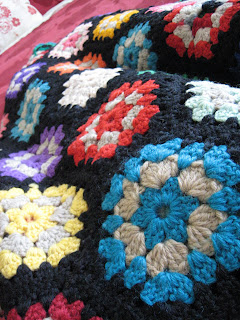
so i did a bit of searching online for patterns, which helped me figure out a few basics like how to get started and how to make corners. and, since my mom taught me to crochet nearly twenty years ago, i needed to brush up on my basics. and then i sat down with my great-grandma's afghan and figured out the pattern.
it's been very therapeutic to have something beautiful to stitch at the last six months. life hasn't felt very beautiful, so it's good to watch yarn unspool off a skein and turn into beautifully colored flowers in my hands. and i love that these flowers will connect me to my grandmothers who created so much beauty themselves.
last summer i decided i wanted to make my own version of an afghan of my mother's that i've always loved. it was made by my great-grandmother. and my mama told me it's called grandma's garden--a very fitting name:

so i did a bit of searching online for patterns, which helped me figure out a few basics like how to get started and how to make corners. and, since my mom taught me to crochet nearly twenty years ago, i needed to brush up on my basics. and then i sat down with my great-grandma's afghan and figured out the pattern.
it's been very therapeutic to have something beautiful to stitch at the last six months. life hasn't felt very beautiful, so it's good to watch yarn unspool off a skein and turn into beautifully colored flowers in my hands. and i love that these flowers will connect me to my grandmothers who created so much beauty themselves.
Subscribe to:
Posts (Atom)